Java
Java is a widely used programming language expressly designed for use in the distributed environment of the internet. It is the most popular programming language for Android smartphone applications and is among the most favored for edge device and internet of things development.

Java was designed to have the look and feel of the C++ language, but it is simpler to use than C++ and enforces an object-oriented programming model. Java can be used to create complete applications that may run on a single computer or be distributed among servers and clients in a network. It can also be used to build a small application module or applet for use as part of a webpage.
It is an object-oriented language similar to C++, but with advanced and simplified features. Java is free to access and can run on all platforms.
Java is: –
-
Concurrent where you can execute many statements instead of sequentially executing it.
-
Class-based and an object-oriented programming language.
-
Independent programming language that follows the logic of “Write once, Run anywhere” i.e. the compiled code can run on all platforms which supports java.
In simple words, it is a computing platform where you can develop applications.
Java is a programming language and computing platform first released by Sun Microsystems in 1995. There are lots of applications and websites that will not work unless you have Java installed, and more are created every day. Java is fast, secure, and reliable. From laptops to datacenters, game consoles to scientific supercomputers, cell phones to the Internet, Java is everywhere!
Elements and principles of Java
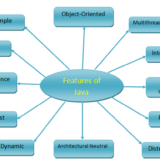
It is difficult to provide a single reason as to why the Java programming language has become so ubiquitous. However, the language’s major characteristics have all played a part in its success, including the following components:
-
Programs created in Java offer portability in a network. The source code is compiled into what Java calls bytecode, which can be run anywhere in a network on a server or client that has a Java virtual machine (JVM). The JVM interprets the bytecode into code that will run on computer hardware. In contrast, most programming languages, such as COBOL, C++, Visual Basic or Smalltalk, compile code into a binary file. Binary files are platform-specific, so a program written for an Intel-based Windows machine cannot on run a Mac, a Linux-based machine or an IBM mainframe. The JVM includes an optional just-in-time (JIT) compiler that dynamically compiles bytecode into executable code as an alternative to interpreting one bytecode instruction at a time. In many cases, the dynamic JIT compilation is faster than the virtual machine interpretation.
-
The code is robust. Unlike programs written in C++ and some other languages, Java objects contain no references to data external to themselves or other known objects. This ensures that an instruction cannot contain the address of data storage in another application or in the operating system itself, either of which would cause the program and perhaps the operating system itself to terminate or crash. The JVM makes a number of checks on each object to ensure integrity.
-
Java is object-oriented. An object can take advantage of being part of a class of objects and inherit code that is common to the class. Objects are thought of as “nouns” that a user might relate to rather than the traditional procedural “verbs.” A method can be thought of as one of the object’s capabilities or behaviors. Being object-oriented is relatively common in today’s programming landscape, but back in 1996, only a handful of languages were implementing object-oriented concepts and design patterns effectively. The ability to develop with a language created from the ground up with object-orientation as its explicit purpose made Java an exciting platform upon which to program.
-
Applet offers flexibility. In addition to being executed on the client rather than the server, a Java applet has other characteristics designed to make it run fast.
-
Developers can learn Java quickly. With syntax similar to C++, Java is relatively easy to learn, especially for those with a background in C.
Java platforms
There are three key platforms upon which programmers develop Java applications:
-
Java SE. Simple, stand-alone applications are developed using Java Standard Edition. Formerly known as J2SE, Java SE provides all of the APIs needed to develop traditional desktop applications.
-
Java EE. The Java Enterprise Edition, formerly known as J2EE, provides the ability to create server-side components that can respond to a web-based request-response cycle. This arrangement allows the creation of Java programs that can interact with internet-based clients, including web browsers, CORBA-based clients and even REST- and SOAP-based web services.
-
Java ME. Java also provides a lightweight platform for mobile development known as Java Micro Edition, formerly known as J2ME. Java ME has proved a very popular platform for embedded device development, but it struggled to gain traction in the smartphone development arena. In terms of smartphone development, Android has become the mobile development platform of choice.
What is Java used for?
Java has been used in different domains. Some of them are listed below:
-
Banking: To deal with transaction management.
-
ReTail Market : Billing applications that you see in a store/restaurant are completely written in Java.
-
Information Technology: Java is designed to solve implementation dependencies.
-
Android: Applications are either written in Java or use Java API.
-
Financial services: It is used in server-side applications.
-
Stock market: To write algorithms as to which company they should invest in.
-
Big Data: Hadoop MapReduce framework is written using Java.
-
Scientific and Research Community: To deal with huge amount of data.