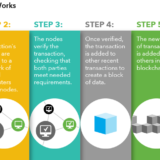
Currently, the global financial system is enormous, but it is very cumbersome to transfer money. While you can send an email around the world in a second, transferring money can take days or even weeks to arrive at its destination. Financial intermediaries are required to transfer any sum of money, each of which takes a service charge. These financial middlemen are more often the victims of fraud than the rest of the economy, which results in greater regulation and higher costs for all parties involved. Blockchain will reduce the number of middlemen while increasing security, both of which will reduce costs. Blockchain will increase the velocity of money, which will increase cash flow and capital investments.
1. Banking access in remote areas: In a country like Zimbabwe and Afghanistan, where all people may not have access to banks or the banking infrastructure itself is not robust due to uncertainties, currency fluctuations and mistrust; Blockchain is useful as a stable form of currency, which would not lose its entire value overnight.
2. International payments: if one wants to transfer money to a person or an institution in another country, they use a bank/money exchange based wire transfer. This process of wire transfer takes two business days because it has to go through domestic Automated Clearing House (ACH) of both nations involved in the transfer. Additionally, international wire transfers have huge minimum costs (approx US $40–52) to initiate the transfer. Using Blockchain, this transaction would be done in less than 15 minutes with transaction fees of around 10–48 US cents.
3. B2B payments: Though Cryptocurrencies (Blockchains biggest application) are garnering a lot of attention these days, an institutional level of acceptance is still missing. The system would get a major push if banks are willing to accept and hold cryptocurrencies as deposits and exchange it for fiat currencies.
The technology has many advantages, a few of which include:
Cryptographically secure
The technology applies a digital signature to create transactions which reduce fraud. Blockchain makes it virtually impossible to remove or change data without being detected by other users.
Decentralized
Today, most of the transactions require approval from a regulatory authority such as banks and the government. In blockchain technology, the verification comes from the consensus of different users.
Improves security
The distributed and encrypted characteristic of blockchain means that it is difficult to hack by evil intentions. Since all the users have a copy of the blockchain, any tampering made gets alerted
Faster processing
Now that, it excludes third-party intermediaries in transactions, the speed to perform the same automatically improves. Also, this comes with round the clock service and does completely away with the 9 to 5 working hours.
Brings automation
The technology is completely programmable and can trigger actions, events, and payments once the conditions are met.